
Successfully navigating the complexities of brand strategy requires a keen understanding of how to measure its impact. This guide delves into the multifaceted approaches to assessing the effectiveness of your brand strategy, moving beyond simple metrics to a holistic evaluation of brand awareness, perception, and ultimately, return on investment. We’ll explore key performance indicators (KPIs), data sources, and analytical methods to provide a comprehensive framework for measuring your brand’s success.
From understanding customer lifetime value (CLTV) and brand equity to analyzing brand performance across various industries, we’ll equip you with the tools and insights to make data-driven decisions that optimize your brand’s trajectory. This isn’t just about numbers; it’s about translating data into actionable strategies that strengthen your brand’s position in the market and foster lasting customer loyalty.
Defining Brand Strategy Success Metrics
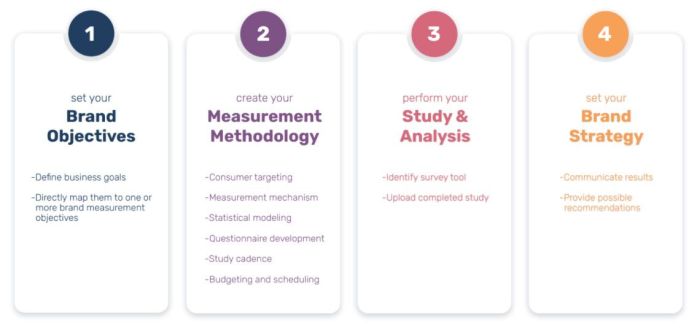
Defining success for a brand strategy requires a multifaceted approach, acknowledging both immediate impacts and long-term growth. A successful brand strategy isn’t solely about immediate sales figures; it encompasses building brand equity, fostering customer loyalty, and achieving sustainable competitive advantage. Therefore, measuring success necessitates a blend of short-term and long-term Key Performance Indicators (KPIs).
Short-term goals often focus on immediate market response and campaign performance. Long-term goals, however, concentrate on building brand awareness, strengthening customer relationships, and ultimately driving sustainable business growth. The choice of KPIs should directly reflect the specific objectives Artikeld in the brand strategy itself. For example, if a primary goal is to increase market share within a specific demographic, KPIs will differ significantly from a strategy focused on enhancing brand perception among a broader audience.
Key Performance Indicators (KPIs) for Brand Strategy Effectiveness
Numerous KPIs can effectively measure the success of a brand strategy. The selection depends heavily on the specific goals and the industry. However, some commonly used KPIs provide a good starting point for assessment.
| KPI | Measurement Method | Data Source | Interpretation Example |
|---|---|---|---|
| Brand Awareness | Surveys, social listening, brand mentions analysis | Market research firms, social media analytics platforms, web analytics | A 20% increase in unaided brand recall indicates successful brand awareness campaigns. |
| Customer Acquisition Cost (CAC) | Total marketing spend / Number of new customers acquired | Marketing campaign data, CRM system | A decrease in CAC from $50 to $40 suggests improved efficiency in customer acquisition. |
| Customer Lifetime Value (CLTV) | Average purchase value x Average purchase frequency x Average customer lifespan | Sales data, CRM system | A CLTV increase from $500 to $750 demonstrates stronger customer loyalty and higher long-term profitability. |
| Net Promoter Score (NPS) | Percentage of promoters minus percentage of detractors | Customer surveys | An NPS increase from 60 to 75 signifies improved customer satisfaction and loyalty. |
| Website Traffic and Engagement | Google Analytics, other web analytics platforms | Website analytics platforms | A 30% increase in website traffic and a 15% increase in time spent on site indicate successful content marketing and improved user experience. |
| Social Media Engagement | Social media analytics platforms (e.g., Facebook Insights, Twitter Analytics) | Social media platforms | A 25% increase in likes, shares, and comments on social media posts suggests successful social media marketing. |
| Market Share | Industry reports, market research data | Market research firms, industry publications | A 5% increase in market share demonstrates successful competition and brand growth. |
| Brand Sentiment | Social listening tools, sentiment analysis software | Social media, online reviews | A shift from predominantly negative to mostly positive brand sentiment indicates successful reputation management. |
Measuring Brand Awareness and Perception
Understanding how consumers perceive your brand is crucial for strategic success. Measuring brand awareness and perception provides valuable insights into the effectiveness of your marketing efforts and helps identify areas for improvement. This data allows for data-driven decision-making, ultimately leading to stronger brand equity and increased return on investment.
Assessing Brand Awareness: Aided and Unaided Recall
Brand awareness is a measure of how familiar consumers are with your brand. It’s typically assessed through aided and unaided recall methods. Aided recall involves prompting respondents with cues, such as a category or a list of brands, to see if they recognize yours. Unaided recall, on the other hand, tests spontaneous brand recognition without any prompts. Higher scores in unaided recall indicate stronger brand recognition and top-of-mind awareness.
For example, if asked to name a coffee shop, a high unaided recall would mean many respondents immediately mention Starbucks. Aided recall might show a higher number of respondents recognizing Starbucks when presented with a list of coffee shop brands.
Measuring Brand Perception: Quantitative and Qualitative Approaches
Brand perception encompasses consumers’ overall feelings, beliefs, and attitudes towards your brand. Quantitative methods, like surveys, use standardized questionnaires to gather numerical data on specific aspects of brand perception, such as quality, value, and trustworthiness. For instance, a survey might ask respondents to rate the brand on a scale of 1 to 5 for each attribute. Qualitative methods, such as focus groups, delve deeper into the reasons behind these perceptions.
Focus groups allow for in-depth discussions and uncover nuanced insights into consumer attitudes and experiences with the brand. A focus group discussing a particular clothing brand might reveal insights into its perceived style, quality, and price point.
Utilizing Social Listening Tools for Brand Sentiment Analysis
Social listening tools monitor online conversations – social media, forums, blogs, and news sites – to track brand mentions and analyze sentiment. This provides a real-time understanding of public opinion and allows for proactive responses to both positive and negative feedback. For example, a company might use social listening to identify a negative trend surrounding a product defect, allowing them to address the issue quickly and mitigate reputational damage.
These tools often provide data visualization, making it easy to identify key themes and trends in brand sentiment.
Methods for Measuring Brand Reputation
Measuring brand reputation involves assessing the overall perception of your brand’s character and trustworthiness. Different methods provide a comprehensive understanding.
- Brand Tracking Studies: Regularly conducted surveys that monitor brand awareness, perception, and sentiment over time.
- Reputation Management Platforms: Software that tracks online mentions and analyzes sentiment across various channels.
- Media Monitoring: Analyzing news articles, blog posts, and other media coverage to gauge public perception.
- Customer Reviews and Feedback: Monitoring online reviews and customer feedback platforms to understand customer experiences.
- Employee Surveys: Gauging employee satisfaction and engagement, which can impact brand reputation.
Analyzing Brand Performance Against Objectives
Successfully implementing a brand strategy requires a clear understanding of its objectives and a robust system for measuring progress. Without this, it’s impossible to determine whether the strategy is achieving its intended goals and maximizing return on investment. This section Artikels key performance indicators (KPIs) and methods for analyzing brand performance against pre-defined objectives.Analyzing brand performance against objectives involves a systematic approach that connects strategic goals to measurable outcomes.
This process allows for informed decision-making, enabling adjustments to the strategy as needed to optimize results. Key to this process is the selection of appropriate metrics that accurately reflect progress toward the desired outcomes.
Key Objectives of a Brand Strategy
A successful brand strategy typically aims to achieve several interconnected objectives. These objectives are often prioritized based on the specific goals of the business and its current market position. Understanding these objectives is crucial for selecting appropriate metrics. Examples of key objectives include increased market share, enhanced customer loyalty, improved brand awareness, and stronger brand perception. For example, a new beverage company might prioritize market share and brand awareness in its initial years, while an established company might focus more on customer loyalty and premium pricing.
Approaches to Measuring Progress Toward Objectives
Various methods exist for tracking progress toward brand strategy objectives. These approaches can be broadly categorized into quantitative and qualitative methods. Quantitative methods rely on numerical data, providing objective measures of performance. Examples include tracking website traffic, sales figures, and social media engagement. Qualitative methods, on the other hand, focus on gathering subjective insights through methods such as customer surveys, focus groups, and social media listening.
Both approaches offer valuable insights, and a comprehensive strategy will typically incorporate both. For instance, a company might use website analytics to measure website traffic (quantitative) alongside customer surveys to gauge customer satisfaction (qualitative) to assess the effectiveness of a new marketing campaign.
Tracking the Return on Investment (ROI) of Brand Strategy Initiatives
Measuring the ROI of brand strategy initiatives is crucial for demonstrating the value of marketing efforts and justifying future investments. Calculating ROI can be challenging, particularly for long-term brand-building initiatives. However, a robust approach involves linking specific marketing activities to measurable outcomes. For example, the ROI of a social media campaign can be assessed by comparing the cost of the campaign to the increase in brand awareness (measured by changes in social media mentions and website traffic) and resulting sales.
More complex initiatives might require a more nuanced approach, potentially using attribution modeling to understand the contribution of different marketing channels to overall sales. A clear understanding of the baseline metrics prior to launching the initiative is crucial for accurate ROI calculation. For example, if a company’s social media engagement increases by 20% following a campaign that cost $10,000, and this increase is directly linked to a $50,000 increase in sales, the ROI can be calculated as ($50,000 – $10,000) / $10,000 = 400%.
This demonstrates a significant return on the investment in the brand strategy initiative.
Assessing Customer Loyalty and Retention
A strong brand isn’t just about awareness and perception; it’s about fostering genuine customer loyalty and retention. These loyal customers are the bedrock of long-term success, driving repeat business, positive word-of-mouth, and ultimately, higher profitability. Measuring and understanding customer loyalty is crucial for refining brand strategy and ensuring continued growth.Measuring customer loyalty and retention involves a multi-faceted approach, focusing primarily on understanding customer lifetime value (CLTV) and the effectiveness of loyalty programs.
Furthermore, continuous monitoring of customer feedback provides invaluable insights for strategic adjustments.
Customer Lifetime Value (CLTV) and its Relationship to Brand Strategy Success
Customer Lifetime Value (CLTV) represents the total revenue a business expects to generate from a single customer throughout their entire relationship. A higher CLTV indicates a more successful brand strategy, as it demonstrates the ability to retain customers and encourage repeat purchases. Calculating CLTV involves considering factors like average purchase value, purchase frequency, and customer lifespan. For example, a subscription-based service can more easily project CLTV based on predictable recurring revenue, whereas a retail store might employ more complex models factoring in purchase patterns and customer retention rates.
Understanding CLTV allows businesses to prioritize customer retention strategies and allocate resources effectively, maximizing return on investment in customer acquisition and retention efforts. A high CLTV directly correlates with a robust and effective brand strategy. It signifies a strong brand-customer relationship built on trust, satisfaction, and value.
Comparison of Customer Loyalty Programs and their Effectiveness
Various loyalty programs exist, each with varying degrees of effectiveness in driving brand loyalty. Points-based systems reward customers with points for purchases, redeemable for discounts or merchandise. Tiered programs offer increasing benefits as customers reach higher spending levels, fostering a sense of exclusivity and reward. Personalized programs leverage data to offer customized rewards and experiences, increasing engagement and relevance.
Finally, community-based programs foster a sense of belonging among loyal customers, creating a strong emotional connection with the brand. The effectiveness of each program depends heavily on its design, implementation, and alignment with the brand’s overall strategy. A poorly designed program, even with a generous reward structure, may fail to drive the desired level of loyalty. For example, a points-based system with complex redemption rules can be frustrating for customers and ultimately counterproductive.
Conversely, a well-designed tiered program can significantly improve customer retention and increase average order value.
Using Customer Feedback to Inform Brand Strategy Adjustments
Customer feedback, gleaned from surveys, reviews, and social media monitoring, provides invaluable insights into customer satisfaction, brand perception, and areas for improvement. Analyzing this feedback allows businesses to identify pain points, understand customer needs, and make data-driven adjustments to their brand strategy. For example, negative reviews highlighting poor customer service can prompt improvements in training and processes. Similarly, positive feedback showcasing a specific product feature can inform future product development.
Regularly monitoring and analyzing customer feedback is crucial for maintaining a customer-centric approach and ensuring the brand strategy remains aligned with evolving customer expectations. This iterative process of feedback collection, analysis, and strategy adjustment is vital for long-term brand success.
Understanding Brand Equity
Brand equity represents the overall value of a brand, encompassing its intangible assets and their influence on consumer behavior and market performance. A strong brand equity translates directly into a competitive advantage, enabling premium pricing, increased customer loyalty, and enhanced resilience against market fluctuations. Understanding and measuring brand equity is therefore crucial for assessing the effectiveness of a brand strategy.Brand equity is multifaceted, stemming from a complex interplay of consumer perceptions and brand-related activities.
It’s not merely a reflection of current market share or sales figures; rather, it represents the cumulative effect of past and present marketing efforts, product quality, customer experiences, and overall brand reputation. Accurately measuring brand equity requires a holistic approach that considers various key components.
Components of Brand Equity
Brand equity is built upon several core components, each contributing to the overall value. These components are interconnected and influence one another. A deficiency in one area can significantly weaken the overall brand equity, highlighting the importance of a balanced approach to brand building.
Measuring Brand Equity
Several established models and methodologies are available for measuring brand equity. These approaches often involve a combination of quantitative and qualitative research methods to gain a comprehensive understanding. A common approach involves surveying consumers to assess their awareness, perceptions, and associations with the brand. This data is then analyzed to quantify the strength of the brand’s equity. Other methodologies might incorporate financial analysis, examining the premium commanded by the brand in the marketplace compared to competitors.
Brand Equity and Brand Strategy Success: A Visual Representation
Imagine a pyramid. The base of the pyramid represents the foundational elements of brand strategy: clear brand positioning, consistent messaging, and targeted marketing efforts. The middle section depicts the components of brand equity: brand awareness, perceived quality, brand associations, and customer loyalty. The apex of the pyramid represents the ultimate outcome: brand strategy success, measured through metrics such as market share, profitability, and customer lifetime value.
The strength and height of the pyramid directly correlate with the success of the brand strategy. A robust base and strong middle section lead to a tall, stable pyramid signifying substantial brand equity and successful brand strategy execution. Conversely, a weak base or a narrow middle section results in a smaller, less stable pyramid, indicating weaker brand equity and less successful brand strategy outcomes.
The visualization emphasizes the direct relationship between a well-defined brand strategy, the resulting brand equity, and the ultimate achievement of brand strategy goals.
The Role of Brand Management in Strategy Success
Effective brand management is not merely a supporting function; it’s the cornerstone of successful brand strategy implementation and sustained growth. A robust brand management system ensures the cohesive execution of the brand strategy across all aspects of the business, driving consistent messaging and ultimately influencing customer perception and loyalty. Without strong brand management, even the most meticulously crafted brand strategy risks failing to deliver its intended results.Brand management plays a vital role in translating the brand strategy into actionable plans and overseeing their execution.
This involves coordinating various departments, from marketing and sales to product development and customer service, to ensure alignment with the brand’s overall vision and values. This integrated approach minimizes inconsistencies and maximizes the impact of brand initiatives. Furthermore, effective brand management enables continuous monitoring and evaluation of the brand’s performance against its strategic objectives, allowing for timely adjustments and optimization.
Brand Management Activities and Business Objectives Alignment
Aligning brand management activities with overall business objectives is crucial for maximizing return on investment (ROI). This requires a clear understanding of the business’s strategic goals and how the brand can contribute to their achievement. For instance, if a company’s primary objective is market share expansion, brand management activities should focus on increasing brand awareness, improving brand perception, and driving customer acquisition.
Conversely, if the primary goal is profitability improvement, brand management might prioritize enhancing customer loyalty and increasing average order value. This alignment necessitates regular communication and collaboration between brand managers and other business leaders to ensure that brand strategies are directly contributing to the company’s bottom line. A well-defined key performance indicator (KPI) framework helps to measure this alignment effectively.
For example, a company aiming for increased market share could track brand awareness and customer acquisition cost as KPIs, directly relating brand management efforts to the business objective.
Consistent Brand Messaging and Experience Across Touchpoints
Maintaining consistent brand messaging and experience across all customer touchpoints is paramount for building a strong and recognizable brand identity. Inconsistent messaging can confuse customers and dilute the brand’s value proposition. Therefore, brand management must ensure that all communication channels—from website and social media to advertising and customer service interactions—deliver a unified and compelling brand narrative. This consistency extends beyond just words; it encompasses visual elements like logos, colors, and fonts, as well as the overall tone and style of communication.
For example, a luxury brand must maintain a consistent image of sophistication and exclusivity across all its platforms, avoiding any discrepancies that might undermine its perceived value. Failing to do so can result in a fragmented brand image, weakening customer trust and hindering brand equity development. A comprehensive brand style guide, regularly updated and meticulously adhered to, is crucial for maintaining this consistency.
Analyzing Brand Strategy Across Different Industries
Brand strategy success isn’t a one-size-fits-all proposition. What works wonders in the tech sector might fall flat in the financial world. Understanding these industry-specific nuances is crucial for effective measurement and ultimately, achieving brand goals. This section will explore how brand strategy success metrics differ across various industries, highlighting key performance indicators (KPIs) and providing examples of successful strategies.The success of a brand strategy is highly dependent on the industry’s competitive landscape, consumer behavior, and the nature of the product or service offered.
Therefore, a standardized approach to measuring success is insufficient. Instead, a tailored approach that considers the unique characteristics of each industry is necessary for accurate assessment.
Industry-Specific KPIs for Brand Strategy Effectiveness
Different industries prioritize different KPIs. For instance, a technology company might focus on app downloads and user engagement, while a retail company might prioritize website traffic and conversion rates. Financial institutions, on the other hand, may heavily emphasize customer trust and brand reputation. This section details some examples.
| Industry | Key Performance Indicators (KPIs) | Example |
|---|---|---|
| Technology | App downloads, user engagement (daily/monthly active users), customer acquisition cost (CAC), churn rate, Net Promoter Score (NPS), social media engagement | A successful tech company like Slack might track daily active users, monthly recurring revenue (MRR), and NPS to measure the success of its brand strategy. High DAU, increasing MRR, and a high NPS indicate strong brand health and effective strategy. |
| Retail | Website traffic, conversion rates, average order value (AOV), customer lifetime value (CLTV), brand awareness (aided/unaided recall), customer satisfaction (CSAT), return on ad spend (ROAS) | A retailer like Nike might use website traffic, conversion rates, and social media engagement to measure brand strategy success. High website traffic translating into sales and positive social media sentiment would signal a successful strategy. |
| Finance | Customer satisfaction (CSAT), Net Promoter Score (NPS), brand trust and reputation (measured through surveys and sentiment analysis), customer retention rate, financial performance (e.g., return on equity, market share), regulatory compliance | A bank like JPMorgan Chase might focus on customer satisfaction scores, Net Promoter Score, and brand reputation scores as key indicators of a successful brand strategy. High scores in these areas would suggest strong customer loyalty and positive brand perception. |
Examples of Successful Brand Strategies Across Industries
Examining successful brand strategies across various sectors reveals how different metrics contribute to overall success. By analyzing these examples, we can better understand the importance of tailoring KPIs to specific industry contexts.
| Company | Industry | Brand Strategy | Key Metrics of Success |
|---|---|---|---|
| Apple | Technology | Focus on premium design, user experience, and brand loyalty | High brand valuation, strong customer loyalty, premium pricing power, high customer satisfaction |
| Starbucks | Retail (Food & Beverage) | Creating a “third place” experience, emphasizing community and high-quality coffee | High customer loyalty, strong brand recognition, widespread store presence, consistent revenue growth |
| Nike | Retail (Apparel & Footwear) | Focus on athletic performance, innovation, and inspiring athletes | High brand awareness, strong market share, successful product launches, high social media engagement |
Ultimately, measuring brand strategy success isn’t a one-size-fits-all endeavor. The key lies in identifying the right KPIs, leveraging diverse data sources, and consistently analyzing the results to inform strategic adjustments. By adopting a holistic approach that considers both short-term gains and long-term growth, businesses can build a robust framework for evaluating their brand strategy’s effectiveness and ensuring sustained success in a dynamic market.
Regular monitoring and adaptation are paramount to ensuring your brand remains relevant, resonant, and ultimately, thriving.
FAQ Explained
What if my brand is new and lacks historical data for measurement?
Focus on establishing baseline metrics and tracking progress over time. Set realistic, short-term goals and use qualitative data (e.g., customer feedback) to supplement limited quantitative data.
How can I balance short-term and long-term brand strategy goals in my measurements?
Develop a balanced scorecard approach, tracking both immediate KPIs (e.g., website traffic) and long-term indicators (e.g., brand equity). This allows for a comprehensive view of your strategy’s impact.
What are some free or low-cost tools to help measure brand strategy success?
Many free social listening tools offer basic sentiment analysis. Google Analytics provides valuable website traffic data. Free surveys can be created using platforms like SurveyMonkey (with limitations on the number of responses).
How often should I measure and review my brand strategy’s performance?
Regular review is crucial. The frequency depends on your industry and goals, but monthly or quarterly reviews are generally recommended, with annual strategic planning sessions.


